
Is Your Car Park Lighting Compliant? A Practical Guide to AS/NZS 1158 and AS 4282
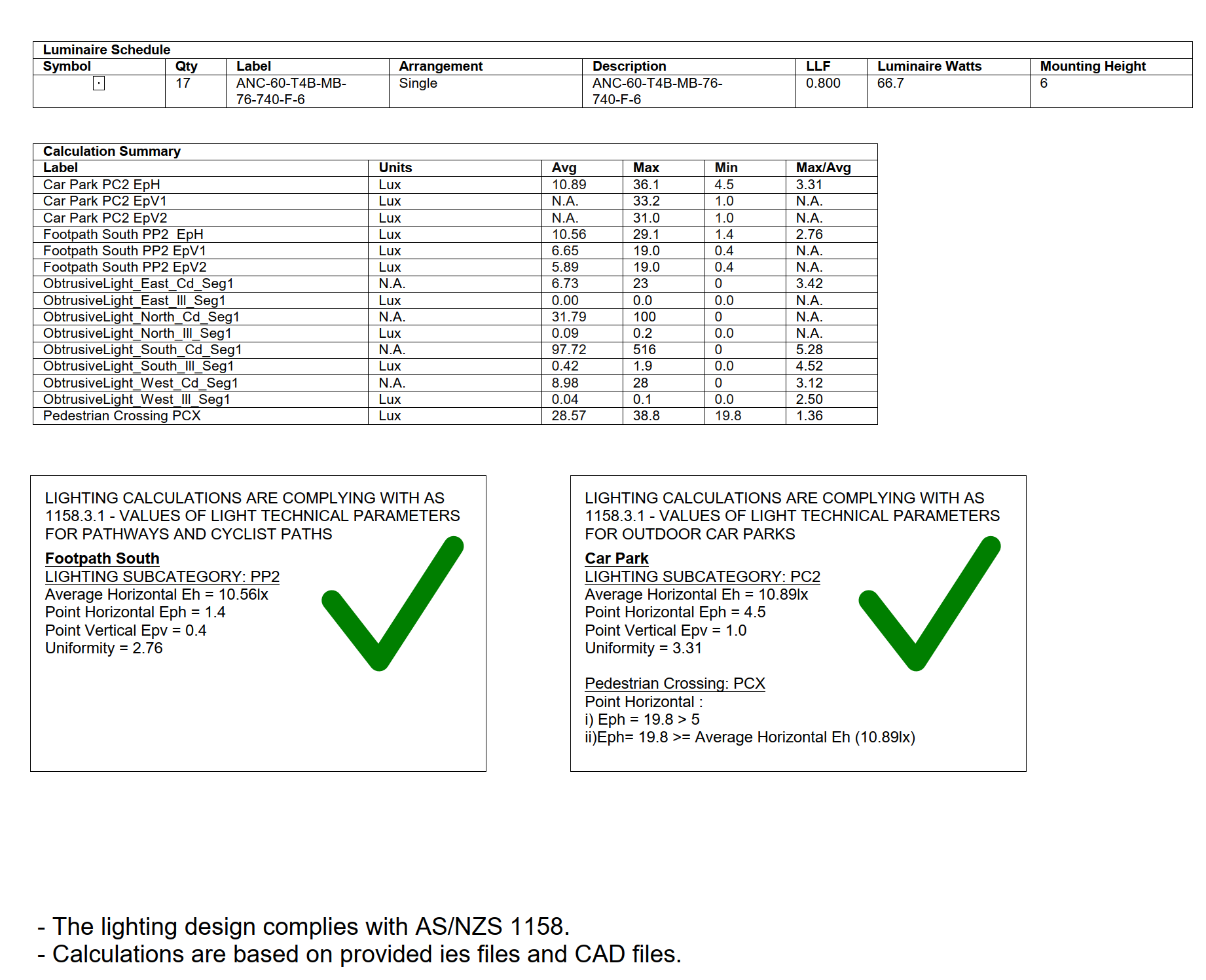
Sample of a lighting compliance report based on the new AS 1158
If you're a facility manager, developer, builder, or body corporate looking into car park lighting — either checking whether an existing car park meets Australian Standards, or planning a new design — you've probably come across two standards that keep showing up: AS/NZS 1158 and AS 4282. This guide breaks down what they actually require, why non-compliance is more common (and more costly) than most people realise, and how to know whether your car park needs attention.
Why car park lighting compliance matters
Car park lighting isn't just about being able to see your way to your vehicle. Poor lighting design creates real risk:
Safety and liability exposure — inadequate lighting is a recognised factor in slip, trip, and personal safety incidents. If an incident occurs in a car park with non-compliant lighting, it can significantly affect liability outcomes for owners and managers.
Building approval and occupancy issues — new developments and major refurbishments generally need to demonstrate lighting compliance as part of the approval process.
Neighbour complaints and obtrusive light disputes — car parks bordering residential properties are a common source of light spill complaints, which can escalate into formal disputes if not addressed at design stage.
Ongoing running costs — over-lit or poorly designed car parks often waste significant energy, while under-lit ones create the risks above. Getting the design right the first time avoids both problems.
AS/NZS 1158 — the lighting performance standard
AS/NZS 1158 is the core Australian/New Zealand standard covering public lighting, including car parks. It sets out the specific lighting categories and performance criteria that apply — things like minimum illuminance levels, uniformity of light across the space, and glare control, depending on how the car park is used and how much pedestrian and vehicle activity it sees.
The key point that trips a lot of people up: not all car parks are treated the same way under the standard. The correct category depends on factors like whether the area is primarily for vehicle movement or pedestrian use, the level of activity, and the surrounding environment. Applying the wrong category — or applying a generic "office car park" template to a space that actually needs a higher category — is one of the most common compliance gaps found during audits.
In practice, this means:
A retail centre car park with high pedestrian foot traffic has different requirements to a low-traffic staff car park.
Ramps, pedestrian walkways within a car park, and entry/exit points may need to be assessed differently to open parking bays.
Existing lighting that "looks bright enough" can still fail to meet the specific illuminance and uniformity criteria once it's actually measured and calculated.
AS 4282 — control of the obtrusive effects of outdoor lighting
Where AS/NZS 1158 tells you how much light and where, AS 4282 governs how much of that light is allowed to spill beyond the car park — onto neighbouring properties, into windows, or up into the night sky.
This becomes particularly relevant for:
Car parks adjacent to residential zones
Sites near sensitive environments (e.g. observatories, ecologically sensitive areas)
Developments where community or council objections around glare and light spill are a risk
Getting AS 4282 wrong doesn't just risk a compliance letter — it's one of the more common causes of neighbour disputes and can hold up development approvals if not addressed early in design.
How do I know if my existing car park is compliant?
If you're managing an existing car park and haven't had it formally assessed, here's a realistic way to think about it:
Visual "it looks fine" is not the same as compliant. Illuminance and uniformity are measured values, not visual impressions — a car park can look adequately lit and still fail on paper.
Age and maintenance matter. Lamp degradation over time (particularly with older fittings) can gradually take a compliant installation out of compliance without any visible warning sign.
Renovations and changes of use can invalidate old compliance. If the car park's function has changed (e.g. more pedestrian traffic, new adjacent residential development), the applicable category may have changed too.
A proper audit involves actual measurement and calculation, not just a walk-through — checking illuminance levels, uniformity ratios, and glare/obtrusive light against the applicable category for your specific site.
What a compliant new design process looks like
For a new car park lighting design, a proper compliance-driven process typically covers:
Correctly identifying the applicable AS/NZS 1158 category for the space (and any sub-areas within it, like pedestrian walkways)
Photometric design and calculation (modelling light levels across the layout before installation, not after)
Checking the design against AS 4282 obtrusive light limits, especially near boundaries
Documentation suitable for building approval and sign-off by a suitably qualified engineer
Getting it checked properly
Because car park lighting sits at the intersection of safety, compliance, energy efficiency, and neighbour relations, it's worth having it reviewed by someone who can assess it against the actual standard requirements — not just "does it look bright enough."
If you're unsure whether your existing car park lighting is compliant, or you're planning a new car park and want the design done right from the outset, I offer independent lighting compliance reviews and design assessments against AS/NZS 1158 and AS 4282, backed by CPEng/RPEQ/RPEV credentials across Victoria, Queensland, and NSW.
Get in touch to discuss your car park lighting project — whether it's a quick compliance check on an existing site or a full design review for a new development.
J George Consulting provides independent electrical engineering consulting across Victoria, Queensland, and NSW, specialising in lighting design compliance, power quality, and building services engineering.